

Social Media Marketing vs SEO for Business Growth
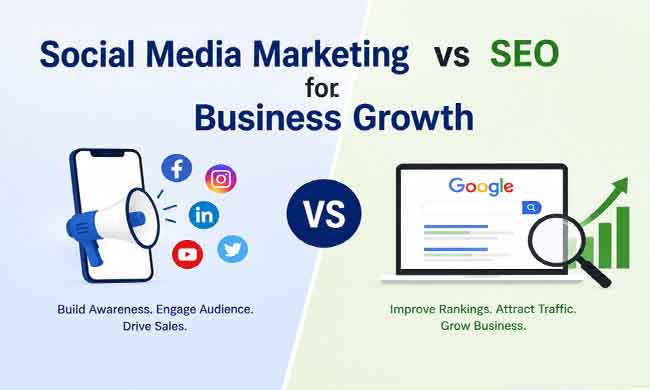
Social Media Marketing vs SEO for Business Growth
Introduction
In today's highly competitive digital landscape, businesses need more than just a website to succeed. Every brand aims to attract new customers, increase online visibility, and generate consistent revenue. Two of the most powerful digital marketing strategies that help achieve these goals are Digital Marketing, social media marketing, and Search Engine Optimization (SEO). Although both approaches focus on increasing brand awareness and driving business growth, they work in different ways and deliver different results.
Many business owners often ask whether they should invest in social media marketing or SEO. The answer depends on business goals, budget, target audience, and long-term strategy. Social media marketing helps businesses connect with audiences instantly through engaging content, advertisements, and community building. SEO, on the other hand, focuses on improving a website's visibility in search engines to attract organic traffic consistently over time.
Rather than viewing these strategies as competitors, businesses should understand their unique strengths and learn how each contributes to sustainable growth. This guide explores the differences, advantages, challenges, and practical applications of both marketing methods to help businesses make informed decisions.
Understanding Social Media Marketing
Social media marketing involves promoting products and services through platforms such as Facebook, Instagram, LinkedIn, TikTok, Pinterest, and X (formerly Twitter). Businesses create engaging content, interact with followers, run paid advertising campaigns, and build communities around their brands.
Unlike traditional advertising, social media enables businesses to communicate directly with customers. Brands can answer questions, receive feedback, launch promotional campaigns, and establish stronger relationships with their audience.
The greatest strength of social media marketing lies in its ability to generate immediate engagement. A creative campaign has the potential to reach thousands or even millions of people within hours. This makes social media an excellent choice for product launches, seasonal promotions, and brand awareness campaigns.
Understanding Search Engine Optimization (SEO)
Search Engine Optimization is the process of improving a website so that it ranks higher in search engine results. When users search for products or services online, SEO helps businesses appear in front of potential customers without paying for every click.
SEO includes several important components such as keyword research, technical optimization, high-quality content creation, internal linking, page speed improvement, mobile responsiveness, and authoritative backlink building.
Unlike social media marketing, SEO requires patience because search engine rankings develop gradually. However, once a website earns strong rankings, it continues attracting valuable visitors for months or even years.
Businesses that invest in SEO often experience consistent traffic growth, increased credibility, and higher conversion rates over time.
Why Businesses Need Digital Marketing Today ?
Modern consumers rely heavily on the internet before making purchasing decisions. Whether they are searching for restaurants, software, healthcare providers, educational institutions, or fashion brands, most buyers begin their journey online.
Without an effective digital marketing strategy, businesses lose opportunities to competitors who maintain a stronger online presence.
Digital marketing helps businesses reach targeted audiences, improve customer engagement, increase website traffic, generate qualified leads, build brand credibility, improve customer loyalty, and increase overall sales. Both SEO and social media marketing contribute significantly toward these objectives, although they accomplish them differently.
Social Media Marketing vs SEO: Core Differences
| Feature | Social Media Marketing | SEO |
|---|---|---|
| Results | Fast | Long-Term |
| Traffic | Social Platforms | Search Engines |
| Cost | Paid & Organic | Long-Term Investment |
| Lead Quality | Good | High |
| Best For | Brand Awareness | Business Growth |
This comparison shows that both strategies have unique strengths and can work together to support sustainable business growth.
Benefits of Social Media Marketing
Social media has transformed the way brands communicate with customers. Instead of relying solely on advertisements, businesses now build meaningful relationships through consistent interaction.
One major advantage is the ability to increase brand awareness rapidly. High-quality videos, engaging graphics, and informative posts can spread across platforms within minutes through shares and recommendations.
Social media also provides valuable customer insights. Businesses can monitor audience behavior, analyze engagement metrics, identify popular content, and adjust marketing strategies accordingly.
Paid advertising on social platforms offers highly detailed targeting options. Businesses can target users based on location, interests, age, profession, education, purchasing behavior, and many other factors.
This level of precision allows companies to maximize advertising budgets while reaching highly relevant audiences.
Benefits of SEO
SEO provides one of the highest returns on digital marketing investment because it focuses on attracting people who are already searching for specific products or services.
Unlike advertisements that disappear once the budget ends, SEO continues delivering traffic over the long term.
Higher search rankings increase brand credibility because users naturally trust websites appearing on the first page of Google.
SEO improves user experience by encouraging faster websites, mobile optimization, clear navigation, and valuable content.
Quality SEO attracts highly targeted visitors who are already interested in specific products or services, resulting in higher conversion rates.
Strong SEO also supports every other marketing channel. Social media campaigns, email marketing, and paid advertising become more effective when users land on an optimized website.
Which Strategy Generates Faster Results?
When businesses need immediate visibility, social media marketing usually delivers faster outcomes.
A well-designed Facebook or Instagram advertisement can begin generating traffic, leads, and sales within hours.
SEO follows a different timeline. Search engines evaluate website quality, authority, technical performance, and content relevance before improving rankings. Depending on competition, noticeable SEO improvements may take several months.
Although SEO requires patience, its long-term benefits often outweigh the short-term gains of paid campaigns. Businesses looking for quick customer acquisition frequently start with social media while simultaneously investing in SEO for sustainable future growth.
Cost Comparison
Budget plays a significant role when choosing a marketing strategy.
Social media marketing can begin with minimal investment. Businesses can create organic posts without spending money, although paid advertising generally produces better results.
SEO requires investment in website optimization, content creation, technical improvements, and quality backlink development. While the initial costs may appear higher, the long-term return on investment often exceeds continuous advertising expenses.
Instead of paying for every website visitor, SEO gradually creates a consistent stream of organic traffic.
For businesses seeking lasting Online Visibility, SEO often becomes the more cost-effective strategy over time.
Audience Intent Makes a Big Difference
One of the biggest differences between SEO and social media marketing is audience intent.
People using social media are typically browsing content for entertainment, inspiration, or social interaction. Although advertisements may capture attention, users are not always actively looking to purchase products.
Search engine users behave differently. Someone searching for "best accounting software," "digital marketing agency," or "website development services" already has a clear need. This makes SEO traffic significantly more valuable because visitors are closer to making purchasing decisions.
Understanding customer intent allows businesses to invest marketing budgets more strategically.
Content Strategy for Both Channels
High-quality content remains the foundation of successful digital marketing.
Social media content focuses on engagement through videos, stories, reels, graphics, polls, and short educational posts.
SEO content emphasizes comprehensive blog articles, landing pages, service pages, buying guides, case studies, and educational resources that answer users' questions in detail.
The most successful businesses create content that serves both purposes. A detailed SEO article can be transformed into multiple social media posts, infographics, short videos, and promotional campaigns, maximizing content value across multiple platforms.
Long-Term Return on Investment
One of the most important factors businesses consider before investing in marketing is return on investment (ROI). While both SEO and social media marketing can produce excellent results, their long-term value differs significantly.
Social media marketing often delivers quick visibility and immediate engagement. A successful advertising campaign can generate leads, website traffic, and sales within a short period. However, once the campaign ends or the advertising budget is exhausted, the traffic usually declines quickly. Businesses must continue investing in new content and paid promotions to maintain consistent performance.
SEO, on the other hand, is a long-term investment that continues delivering value long after the initial optimization work is completed. A well-optimized website with high-quality content can rank on search engines for months or even years, attracting visitors without paying for every click. This makes SEO one of the most cost-effective digital marketing strategies for businesses focused on sustainable growth.
Companies that consistently invest in Business Growth through SEO often experience increasing website authority, stronger search rankings, and higher customer trust over time.
Common Mistakes Businesses Make
Many businesses fail to achieve their marketing goals because they rely on only one strategy or make avoidable mistakes.
One common mistake is expecting SEO to produce instant results. Search engine optimization requires patience, consistency, and continuous improvements. Businesses that stop optimizing their websites after a few weeks often miss the long-term benefits.
Another mistake is using social media only for promotional content. Constantly posting advertisements without providing educational or entertaining content reduces engagement and weakens audience trust.
Some businesses also ignore website quality. Even the best social media campaigns or SEO efforts cannot succeed if visitors land on a slow, outdated, or poorly designed website.
Publishing low-quality content, targeting the wrong audience, neglecting mobile optimization, and failing to analyze marketing performance are additional mistakes that reduce overall effectiveness.
How SEO and Social Media Work Together ?
Although many people compare SEO and social media marketing, the most successful businesses combine both strategies instead of choosing only one.
SEO helps users discover your business through search engines, while social media keeps your audience engaged and encourages ongoing interaction.
For example, a company can publish a detailed blog article optimized for search engines and then promote that article across Facebook, LinkedIn, Instagram, and other social platforms. This increases website traffic while also improving brand awareness.
Social media also encourages users to share valuable content, increasing its reach and creating opportunities for natural backlinks and brand mentions. While social signals are not direct ranking factors, increased visibility often results in more website visits and stronger online authority.
Businesses that integrate both marketing channels create a complete digital marketing ecosystem that supports long-term success.
Which Businesses Should Focus on Social Media?
Social media marketing is particularly effective for businesses that rely on visual content, customer interaction, and frequent promotions.
Fashion brands, restaurants, beauty salons, fitness centers, travel agencies, cafes, event organizers, influencers, and retail stores often benefit significantly from active social media campaigns.
Businesses launching new products or seasonal offers also achieve excellent results through paid social advertising because they can reach highly targeted audiences almost instantly.
Companies aiming to build strong communities around their brands should prioritize consistent social media engagement while maintaining professional branding across all platforms.
Which Businesses Should Prioritize SEO?
SEO is ideal for businesses whose customers actively search online before making purchasing decisions.
Professional service providers such as law firms, healthcare clinics, educational institutions, software companies, digital agencies, construction firms, real estate businesses, accounting firms, and consulting companies benefit greatly from strong search engine rankings.
Local businesses also gain significant advantages through local SEO strategies that help customers discover nearby products and services.
Since search engine users often have clear buying intent, SEO generally produces highly qualified leads with greater conversion potential.
Choosing the Right Strategy Based on Business Goals
The ideal marketing strategy depends on business objectives.
If a company wants immediate visibility, product awareness, or event promotion, social media marketing offers the fastest results.
If the goal is generating consistent website traffic, improving online authority, and reducing long-term advertising costs, SEO becomes the stronger investment.
Many successful organizations allocate budgets to both strategies. Social media creates awareness and engagement, while SEO captures users actively searching for solutions.
This balanced approach maximizes online exposure and creates multiple customer acquisition channels.
The Future of Digital Marketing
Digital marketing continues evolving as technology advances and customer behavior changes.
Artificial intelligence, voice search, personalized content, automation, predictive analytics, and advanced search algorithms are transforming how businesses connect with customers.
Despite these innovations, one principle remains constant: businesses that provide valuable content and excellent user experiences consistently outperform competitors.
SEO will continue rewarding websites that publish informative, trustworthy, and user-focused content.
Social media platforms will continue prioritizing authentic engagement, creative storytelling, and meaningful customer interactions.
Businesses that adapt to these changes while maintaining a strong digital presence will remain competitive in the years ahead.
Final Verdict
The debate between social media marketing and SEO should not be viewed as a competition where one strategy defeats the other.
Social media marketing excels at creating conversations, increasing engagement, and generating immediate attention.
SEO specializes in attracting qualified visitors, building long-term credibility, and delivering sustainable organic traffic.
When used together, these strategies create a comprehensive marketing system capable of increasing visibility, strengthening customer relationships, and improving overall business performance.
Instead of asking which strategy is better, businesses should ask how both strategies can work together to achieve long-term success.
A smart investment in Digital Marketing combines the immediate impact of social media with the lasting value of search engine optimization, creating a powerful foundation for future business growth.
Conclusion
Every business has unique goals, audiences, and marketing challenges. While social media marketing offers fast engagement and excellent promotional opportunities, SEO provides consistent organic traffic and long-term visibility. Choosing one over the other may limit business potential.
Organizations that integrate both strategies build stronger brands, improve customer trust, increase website traffic, and generate higher-quality leads. As competition continues to grow in the digital marketplace, businesses that invest in both SEO and social media marketing will be better positioned for sustainable success.
Whether you are a startup, a local business, or an established enterprise, combining these powerful marketing techniques will help you achieve measurable results, strengthen your online presence, and support continuous business growth.
Frequently Asked Questions (FAQs)
1. Which is better for long-term business growth, SEO or Social Media Marketing?
SEO is generally better for long-term business growth because it delivers consistent organic traffic and improves website authority over time. Social media marketing complements SEO by increasing engagement and brand awareness.
2. Can a business succeed with only Social Media Marketing?
Yes, but relying only on social media can limit long-term growth. Combining social media with SEO creates a stronger digital presence and improves customer acquisition.
3. How long does SEO take to show results?
SEO usually takes between three and six months to produce noticeable improvements, depending on competition, website quality, and optimization efforts.
4. Is Social Media Marketing more affordable than SEO?
Social media marketing can start with a smaller budget, but ongoing advertising costs may increase over time. SEO requires an initial investment but often provides a better long-term return.
5. Should small businesses invest in SEO?
Absolutely. SEO helps small businesses compete with larger competitors by attracting local and targeted customers through search engines.
6. Can SEO and Social Media Marketing work together?
Yes. SEO drives organic traffic to your website, while social media increases content visibility, customer engagement, and brand recognition. Together they create a highly effective marketing strategy.
7. Which strategy generates higher-quality leads?
SEO typically generates higher-quality leads because users searching on Google usually have stronger purchase intent than users casually browsing social media platforms.
Comments